 FAQ – Rabbi for Jewish Wedding
Who can officiate a Jewish wedding?
A Jewish wedding can be officiated by a person with education and knowledge of Jewish tradition, capable of leading the ceremony with coherence, respect and meaning. In many contemporary contexts, especially outside Israel, there are different ways of officiating Jewish ceremonies depending on the type of wedding and the couple’s story.
Is a rabbi required for a Jewish wedding?
Not always. In interfaith weddings, symbolic ceremonies or destination weddings, many couples choose Jewish ceremonies officiated by a Jewish officiant with solid training, while preserving the structure and meaning of the ritual.
What is the chuppah and how should it be for a Jewish wedding?
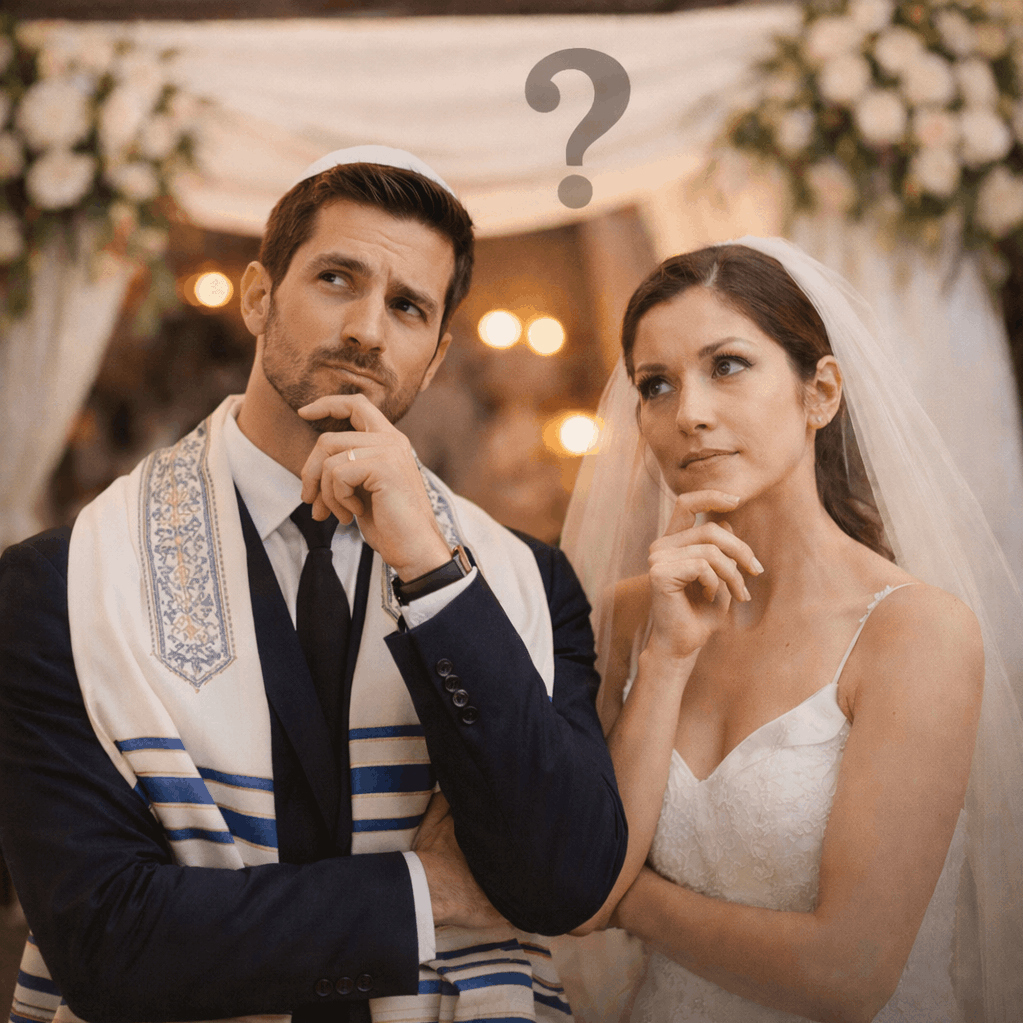
The chuppah represents the home the couple builds together. Traditionally, it consists of a canopy supported by four poles and open on all four sides. It can be simple or elaborate, as long as its essential symbolism is preserved.
Can the chuppah be personalized?
Yes. The chuppah can be personalized in materials, fabrics and colors. Many couples use a family tallit, floral arrangements or structures designed specifically for their ceremony, always respecting its symbolic meaning.
Who can stand under the chuppah?
In addition to the couple, close family members or other significant people may stand under the chuppah, depending on the approach of the ceremony and the wishes of the couple.
Do you officiate interfaith Jewish weddings?
Yes. I officiate interfaith Jewish weddings adapted to the couple’s story, maintaining Jewish content and symbolism, and explaining the ceremony clearly for guests from different religious and cultural backgrounds.
Do you officiate weddings together with officiants from other religions?
Yes. I officiate Jewish ceremonies in co-officiation with officiants from other religious or ceremonial traditions, always with a clear and respectful structure for each part of the ceremony.
Have you officiated weddings with Catholic priests?
Yes. I have extensive experience with this type of ceremony. I have officiated shared ceremonies with Catholic priests, coordinating the script in advance so that each tradition has its own space, language and spirituality.
Do you officiate weddings with masters of ceremonies or civil celebrants?
Yes. I officiate Jewish weddings together with masters of ceremonies or civil celebrants, especially in interfaith weddings.
Do you officiate weddings with officiants from Persian or Eastern religions?
Yes. I have officiated Jewish weddings in shared ceremonies with officiants from Persian and Eastern traditions, respecting the identity of each culture and building a balanced and well-structured ceremony.
How is a ceremony organized when there are two or more officiants?
The key is careful preparation of the script. Each officiant has their own space, timing and language. The ceremony is conceived as a respectful dialogue between traditions, not as an improvised overlap.
Does a Jewish ceremony lose its meaning in a shared wedding?
No. When it is well designed, the Jewish part of the ceremony fully maintains its symbolism, structure and depth, even within a ceremony shared with other traditions.
Is the ceremony explained for non-Jewish guests?
Yes. The meaning of the chuppah, the blessings and the main symbols is explained clearly and accessibly so that all guests can understand and experience the ceremony. I also help the couple prepare a program, if they wish, to be given to guests before the ceremony.
In which languages can the ceremony be officiated?
Ceremonies can be conducted in Spanish, English, Portuguese, Catalan, or a combination of languages, depending on the couple and their guests. The traditional parts of the ceremony are always chanted in Hebrew.
Can the Jewish ceremony be adapted to the wedding venue?
Yes. The ceremony can be adapted to different settings — country estates, castles, gardens, private venues, seaside locations or indoor spaces — as long as the essential elements of the ritual are respected.
Does a Jewish ceremony have to be long?
Not necessarily. The length is adapted to the couple and the type of wedding. It can be shorter or longer, always maintaining a clear and meaningful structure.
Which parts of the Jewish ritual are essential and which are optional?
There are core elements of the Jewish ritual and others that can be adapted or omitted depending on the type of ceremony. These decisions are defined together with the couple during the preparation process.
In which countries do you officiate Jewish weddings?
I officiate Jewish weddings in Spain, Portugal, Italy and anywhere in Europe. I regularly work with couples who live abroad and choose Europe as the destination for their Jewish wedding.
FAQ – Rabbi for Jewish Wedding
A Jewish wedding is much more than a rite. It is a moment that connects history, family and future. That is why choosing who accompanies that moment is not a minor decision.
info@jewishceremony.com